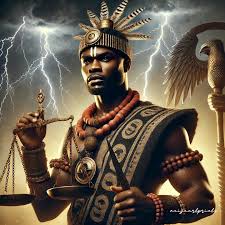
Amadioha, Igbo God of thunder and lightening
Understanding Amadioha in Igbo Mythology and Traditional Religion
The traditional religion of the Igbo people of Eastern Nigeria, commonly known as Odinani (also called Odinala), is one of Africa’s oldest and most sophisticated indigenous belief systems. Rooted in the interconnectedness of spirituality, morality, nature, and community, Odinani provides a comprehensive worldview that has guided Igbo society for centuries. At the heart of this tradition is a rich cosmology inhabited by divine beings known as Alusi (Arusi), who govern various aspects of existence and serve as intermediaries between humanity and the Supreme Creator.

Igbo Cosmology
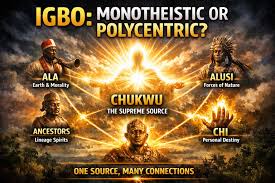
The spiritual universe of the Igbo people is populated by numerous deities and ancestral spirits, each with distinct roles and responsibilities. Among the most prominent are:
- Chukwu (or Chineke): The Supreme Creator and source of all existence.
- Ala (Ani): The Earth goddess, guardian of morality, fertility, and the ancestors.
- Anyanwu: The deity associated with the sun, light, and life.
- Ikenga: The spirit of personal achievement, strength, and success.
- Idemili: The water deity associated with purity, prosperity, and sacred rivers.
- Ekwensu: A complex spiritual figure often associated with conflict, change, negotiation, and trickery.
- Amadioha: The powerful deity of thunder, lightning, justice, and divine retribution.
Together, these deities maintain harmony between the physical and spiritual worlds, reinforcing the moral and social order of traditional Igbo society.
Who is Amadioha?
Among the Alusi, Amadioha is one of the most revered and feared. As the god of thunder, lightning, and justice, he symbolizes divine authority, moral order, and the collective will of the community. His power extends beyond natural phenomena; he is regarded as the divine enforcer of truth and righteousness. In traditional Igbo society, Amadioha was believed to punish hidden crimes such as theft, oppression, murder, and broken oaths. Individuals accused of serious offenses could swear solemn oaths before him to prove their innocence. The fear of divine punishment was so great that many preferred confession or restitution rather than risking Amadioha’s wrath.
Anthropological studies of Igbo religion describe oath-taking before deities as an important mechanism for maintaining honesty, accountability, and social stability. Through this role, Amadioha functioned as a spiritual guardian of justice, ensuring that law, morality, and religion remained inseparable within traditional Igbo society.
Roles and Functions
Amadioha performs several important functions within Igbo traditional religion.
Enforcer of Justice
Amadioha is regarded as the divine enforcer of Odinani, the moral and customary law of the Igbo people. He is believed to punish liars, oath-breakers, murderers, thieves, and those who secretly commit acts of injustice. His divine judgment is symbolized by thunder and lightning, which are viewed as manifestations of his authority.
Guardian of Sacred Oaths
One of Amadioha’s most significant responsibilities is safeguarding sacred agreements. Oaths sworn in his name were considered binding, and violating them was believed to invite severe supernatural consequences. This belief helped preserve honesty, trust, and accountability within traditional communities.
Provider of Rain and Prosperity
Although widely feared for his power to punish wrongdoing, Amadioha is also regarded as a benevolent provider. He is invoked for rain, abundant harvests, fertility, prosperity, peace, protection, and the general well-being of families and communities.
Regional Traditions
Beliefs about Amadioha vary across different Igbo communities. In some regional traditions, he is associated with acts of creation or the origin of humanity, although most Igbo cosmologies identify Chukwu as the Supreme Creator. Likewise, some communities regard him as a deity closely associated with the heavens, with thunder and lightning serving as expressions of his divine judgment.
Powers and Symbols
Amadioha’s authority is expressed through several powerful symbols and natural phenomena.
Thunder and Lightning
Thunder and lightning are regarded as the visible signs of Amadioha’s presence and judgment. Lightning strikes were traditionally interpreted as evidence of divine intervention, particularly when associated with acts of injustice or violations of sacred law.
Some oral traditions also maintain that individuals struck by Amadioha’s lightning bore distinctive marks, signifying divine punishment, although such beliefs vary among different communities.
Divine Communication
In traditional Igbo cosmology, unusual natural events—especially lightning strikes—could be interpreted as messages from Amadioha. Traditional priests, known as Dibia, were often consulted to determine the spiritual significance of such events and to uncover hidden wrongdoing or malicious charms believed to threaten the community.
Mythology and Cultural Traditions
Etymology
One popular interpretation derives the name Amadioha from Amadi (“freeborn”) and Oha (“the people” or “community”), reflecting his association with communal justice and the protection of society. While this explanation is widely cited, scholars continue to debate the precise linguistic origin of the name.
Sacred Shrines
Amadioha was worshipped throughout much of Igboland, and numerous communities maintained shrines dedicated to him. One of the best-known historical shrines associated with his worship is located in Ozuzu, in present-day Etche Local Government Area of Rivers State, Nigeria.
Regional Names
Across different Igbo-speaking communities, Amadioha is also known by names such as Kamalu, Kamanu, Igwe, and Amadiora, reflecting the regional diversity of Igbo religious traditions.
Legacy in Modern Igbo Culture
The spread of Christianity during the colonial period significantly transformed religious life throughout Eastern Nigeria, leading many communities to abandon or modify traditional religious practices. Nevertheless, Amadioha remains one of the most recognizable figures in Igbo mythology and cultural history.
Today, he continues to appear in folklore, literature, academic scholarship, festivals, artistic expressions, and discussions of African indigenous religions. For many people, Amadioha represents not only a traditional deity but also the enduring Igbo ideals of justice, integrity, accountability, and communal responsibility.
Conclusion
Amadioha stands as one of the most revered deities in the traditional religion of the Igbo people, embodying the principles of justice, truth, divine authority, and communal harmony. As the god of thunder and lightning, he is believed to punish wrongdoing, uphold sacred oaths, and protect the moral order of society. While feared for his power to exact divine justice, he is also honored as a benevolent provider who grants rain, fertility, prosperity, and protection to those who live righteously. Although beliefs and traditions surrounding Amadioha vary across different Igbo communities, his enduring significance reflects the depth and sophistication of Odinani, where spirituality, morality, nature, and community are inseparably linked. Today, Amadioha remains a powerful symbol of Igbo cultural heritage, illustrating the enduring values of justice, accountability, and respect for the sacred within one of Africa’s oldest indigenous religious traditions.
About the Author